Buying a Cheap Used Car in Louisiana: Title, Registration & Fees
Ask AI About Pull-A-Part
TO TURN YOUR JUNK CAR INTO CASH
Get the phone number to a location near you by enterging your zipcode.
Find a Local Junkyard
ALABAMA
ARIZONA
COLORADO
FLORIDA
GEORGIA
INDIANA
KENTUCKY
LOUISIANA
MISSISSIPPI
NEW MEXICO
NORTH CAROLINA
OHIO
PENNSYLVANIA
SOUTH CAROLINA
TENNESSEE
TEXAS
Pull-A-Part | August 21, 2026
Buying a Cheap Used Car in Louisiana: Title, Registration, and Fees
A $2,500 car is not a $2,500 expense. When you're buying a used car in Louisiana, the asking price is only the first number. On top of it you owe state and parish sales tax, a title fee, a handling fee, and a plate fee, and you have a limited window to pay before penalties start. Louisiana also has one requirement that trips up more buyers than anything else: the seller's signature transferring the title has to be made in front of a notary.
None of it is complicated once you know the sequence. Below is what the paperwork actually costs, what the notary rule means in practice, exactly what to bring to an OMV office, the deadline that applies to your purchase, and how to look a budget car over carefully before any money changes hands.
Private seller or licensed lot? It changes what you handle
Inexpensive vehicles usually change hands one of two ways: privately between individuals, or through a licensed business. Both are legitimate, but the paperwork falls differently.
In a private sale, all of it is on you. You have to get the title properly assigned and notarized, complete the vehicle application, and carry the whole packet to the OMV along with the tax and fees. If the seller stops answering the phone after handing you the keys and something on the title turns out to be wrong, you're the one holding the problem.
A licensed business is set up to produce the documents the OMV expects, including an itemized invoice with a full vehicle description and the business's permit number. Vehicles at the low end of the market often overlap in price between the two channels, so the paperwork difference is worth weighing. If you're comparing listings, a lot such as Pull-A-Part's selection of affordable used cars in Baton Rouge sits in the same range as many private-party ads. Inventory at any low-cost lot turns over constantly, so check what's currently available before you drive out. Either way, ask the seller directly how the title will be signed and notarized before you agree on a price.
What buying a used car in Louisiana really costs
The Louisiana Office of Motor Vehicles (OMV) charges the same fixed amounts on a used-vehicle transfer whether the car cost $2,000 or $20,000:
- Title fee — $68.50. Charged on every titling transaction.
- Handling fee — $8.00.
- Local fee — up to $6.00. May apply depending on where the transaction is processed.
- License plate fee — $20.00 minimum. Automobile plates are calculated at 0.1% of the vehicle's value per year, but the calculation uses a minimum base of $10,000 and plates are sold in two-year increments. On any car valued below roughly $10,500, that lands on the $20 floor.
- Lien recordation — $15.00 or $10.00. Only if you're financing, depending on the document used.
Added together, a cash purchase with a new plate typically runs a little over $100 in fixed charges. Amounts do get revised, so check the OMV's current title, registration, and plate fee schedule before you budget to the dollar.
Then there's tax, which on a cheap car is usually the biggest add-on. Sales and use tax is assessed on the selling price shown on the title or bill of sale, at the combined state and local rate for the buyer's domicile — where you live, not where the seller lives. Rates differ meaningfully from parish to parish, so look yours up on the OMV parish tax table before you start shopping, not after you've committed.
One point worth stating plainly: if a seller offers to write a lower price on the bill of sale to shrink your tax bill, decline. The figure on your paperwork is the figure the OMV uses, and it should match what you actually paid.
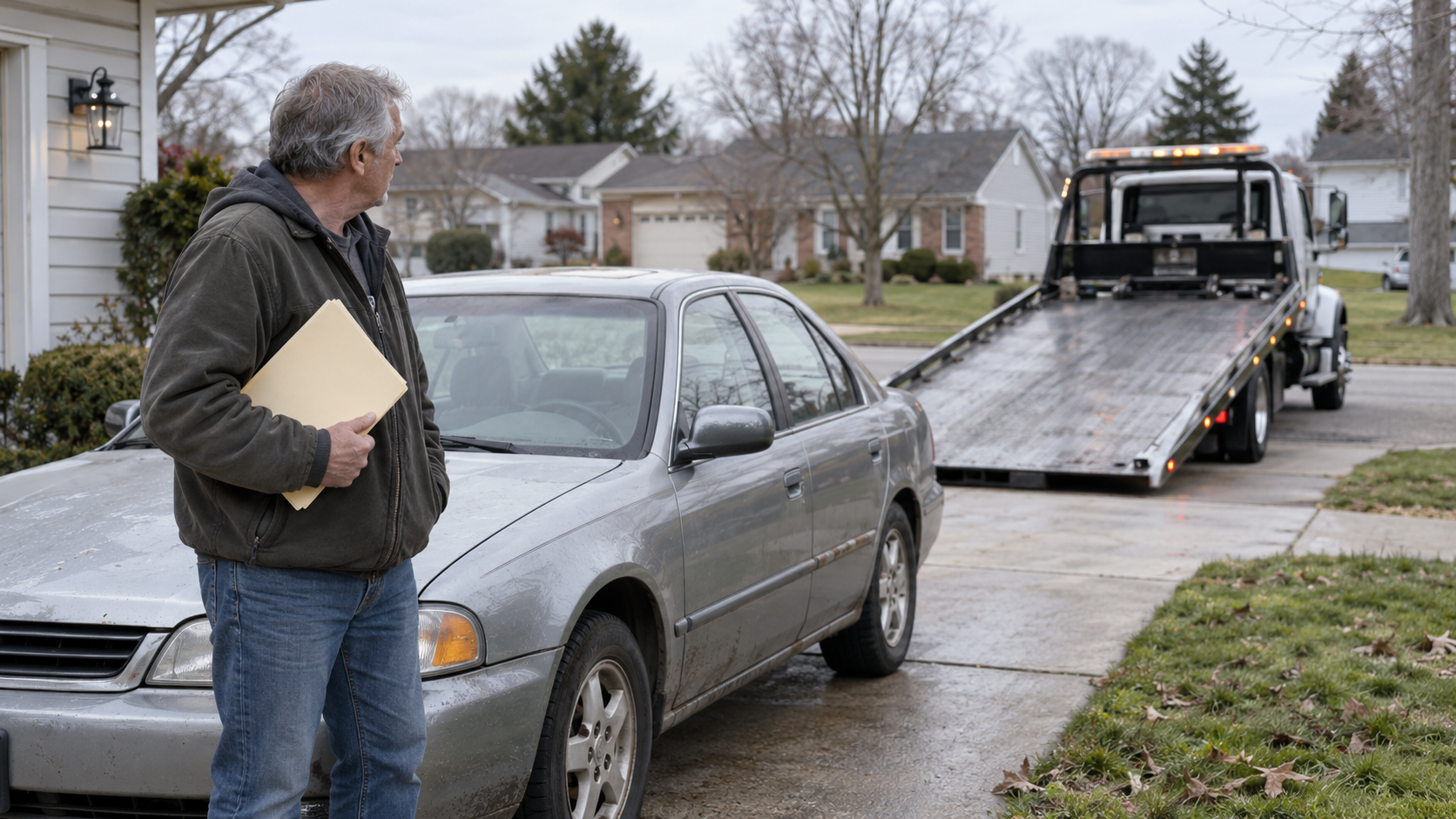
If the vehicle you're replacing has reached the end of its useful life, that can help fund the change. Rather than letting it sit in the driveway, you may be able to sell it for cash and put the money toward the title, plate, and tax on the replacement.
The notarized title: Louisiana's most common paperwork mistake
This is the requirement that sends buyers back to sellers they can no longer reach. In Louisiana, the certificate of title must be assigned by the seller to the buyer before a notary. The OMV will accept the file if the title, the bill of sale, or the invoice is notarized. In certain lending situations, an authorized agent of a federally insured financial institution may witness the assignment instead of a notary.
In practice, that means don't sign in a parking lot. Arrange to meet the seller at a notary's office, a bank, or a public tag agent, and have the assignment executed there while both of you are present. It takes one extra stop and it removes the most likely reason your file gets rejected.
While the title is in front of you, check three more things before money changes hands:
- The seller's name matches the title. If the title was signed by a previous owner and never transferred into the seller's name — an "open title" — the OMV processes it as more than one transfer, and tax and fees come due on each assignment. That can roughly double what you pay in paperwork.
- Any lien is released. If a lender is listed, the title needs to show the lien released, or you'll need a release document from that lender.
- The VIN matches the vehicle. Compare the number on the title against the plate at the base of the windshield and the sticker in the driver's doorjamb.
If the vehicle isn't exempt from odometer requirements and the back of the title has no odometer disclosure section, a separate odometer statement has to go into the file as well.
What to bring to an OMV office or public tag agent
Used-vehicle titling can be handled at an OMV customer service center, at a public tag agent, or by mail to OMV headquarters. Based on the OMV's requirements for titling and registering a used vehicle, plan to bring:
- A completed Vehicle Application, form DPSMV 1799
- The current certificate of title, assigned to you before a notary, with any lien properly released
- An odometer disclosure statement, if one isn't already on the title and the vehicle isn't exempt
- An original notarized bill of sale or invoice showing the actual price paid and a full description of the vehicle — not required separately if the selling price appears in the title assignment
- A copy of each owner's current, valid photo ID, if you want a license plate
- Proof of liability insurance coverage, if you want a license plate
- Payment for the fees and taxes owed
The ID and insurance requirements are tied specifically to getting a plate, so don't show up without them expecting to drive home legally. Appointments are available at OMV offices and many public tag agents, and booking one is worth the two minutes it takes.
The 40-day clock on taxes
Under OMV policy, tax on a purchased vehicle is due within 40 days of the purchase or delivery date. Pay after that and penalty and interest are assessed. Just as important, the OMV will not issue a title or registration until the applicable taxes are paid — so letting the deadline slide doesn't only cost money, it leaves you driving a car that isn't legally in your name.
The practical takeaway for a budget purchase: treat the tax and fees as part of the price, not as something to deal with next month. If paying them 40 days out would be a stretch, the car costs more than you can afford right now.
Inspection stickers and emissions testing in Louisiana
Louisiana's vehicle inspection requirements are in transition. A 2026 state law ends the traditional annual inspection sticker — the brake tag — for most personal vehicles and replaces it with a windshield decal tied to your registration, with the new system scheduled to begin January 1, 2027. A few municipalities have historically run their own inspection programs as well. Because the rules are actively shifting, confirm what applies on the day you buy rather than relying on what was true last year, and verify with the OMV or Louisiana State Police if you're unsure.
What hasn't changed is emissions testing in the Baton Rouge area. Driven by federal Clean Air Act requirements, the state's motor vehicle inspection and maintenance program covers gasoline-fueled vehicles with a gross vehicle weight rating of 10,000 pounds or less registered in Ascension, East Baton Rouge, Iberville, Livingston, and West Baton Rouge parishes. If you live in one of those five parishes, an older car with an illuminated check-engine light is a real financial risk, since a lit malfunction indicator lamp is a common reason a vehicle fails an OBD-II emissions check.
Affordable doesn't mean flawless
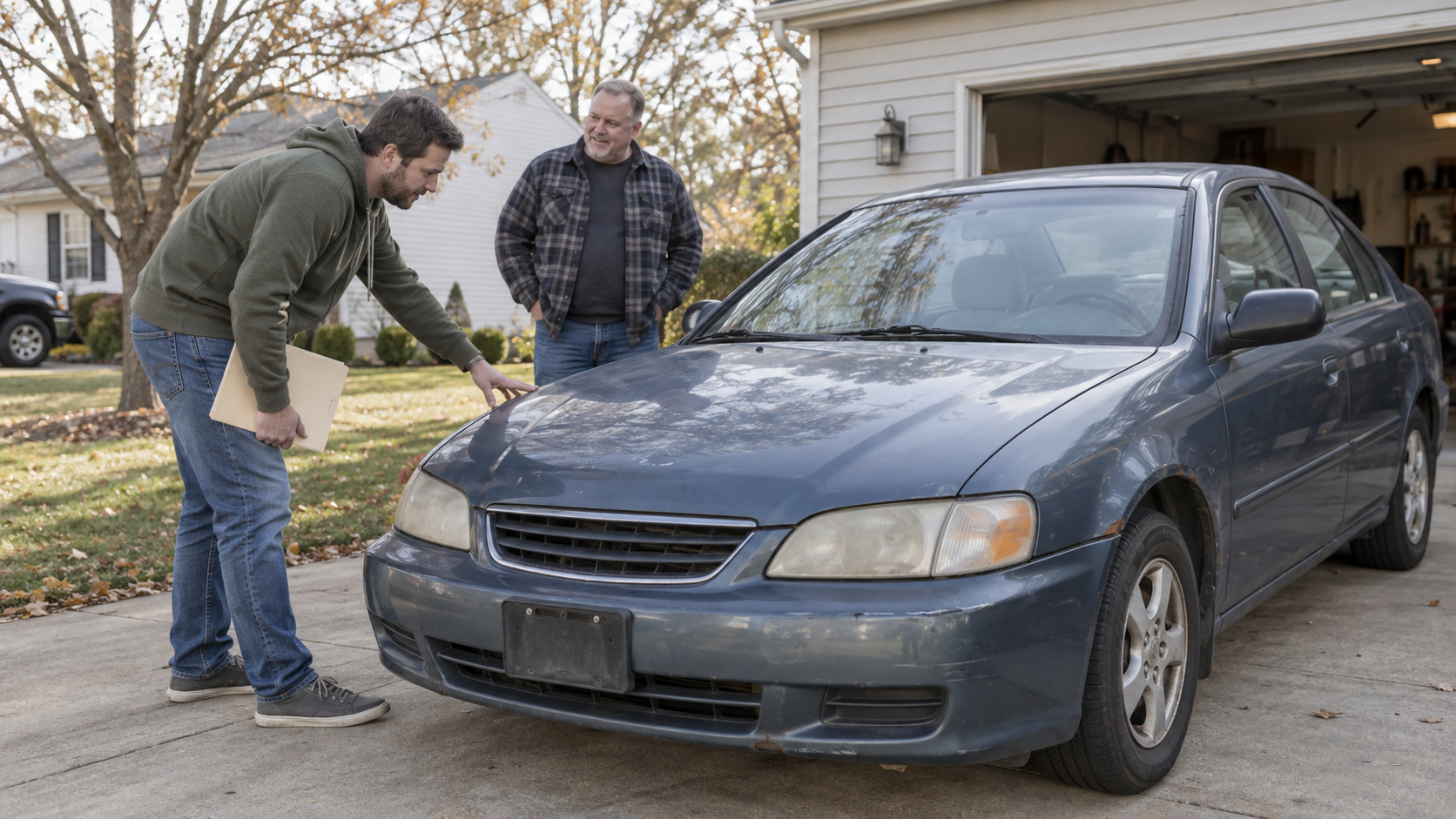
A car priced at the bottom of the market is priced there for a reason: age, mileage, cosmetic condition, deferred maintenance, or some mix of all four. That's not a dealbreaker — plenty of high-mileage vehicles have years of useful service left — but it does mean the inspection matters more on a cheap car, not less.
Before you hand over any money:
- Start it cold. Ask the seller not to warm it up before you arrive. A cold start exposes hard starting, rough idle, smoke, and noises that disappear once everything is up to temperature.
- Check every fluid. Milky or foamy oil, coolant with oil in it, and transmission fluid that's dark and smells scorched all point to repairs that can exceed what you're paying for the car.
- Drive it properly. Not around the block — get it to highway speed for twenty minutes. Watch the temperature gauge, feel how it shifts under light and hard throttle, and check whether it pulls under braking.
- Look for water damage. Silt or a waterline in the spare tire well, a persistent mildew smell, rust on unpainted metal under the seats and on seat rails, and moisture inside the headlights are all worth walking away over.
- Read the tire date codes. The last four digits of the DOT code give the week and year of manufacture. Rubber more than about six years old can be hard and cracked regardless of tread depth, and four tires is a meaningful expense on a low-priced car.
- Scan it. An inexpensive OBD-II reader pulls stored trouble codes in seconds. If readiness monitors aren't set, codes were likely cleared recently — which tells you something on its own.
- Run the VIN. Look for a branded title such as salvage, flood, or rebuilt, and check for unrepaired safety recalls using the free NHTSA recall lookup.
The single most useful thing you can do is pay an independent mechanic for a pre-purchase inspection. It typically costs a fraction of one major repair, and a good shop will find things a careful buyer won't. Whether you're answering a private-party ad or looking at budget-friendly used cars in Lafayette, the same walkthrough applies. No seller can promise that a particular used vehicle will suit every buyer's needs, so the inspection is how you find out whether this one suits yours.
Budget for what comes after the purchase
Set aside money for the first round of maintenance before you spend every dollar on the car itself. On a vehicle that's changed hands cheaply, tires, brakes, a battery, belts, hoses, and a full fluid service are common in the first few months, and the previous owner's maintenance records are usually thin or nonexistent.
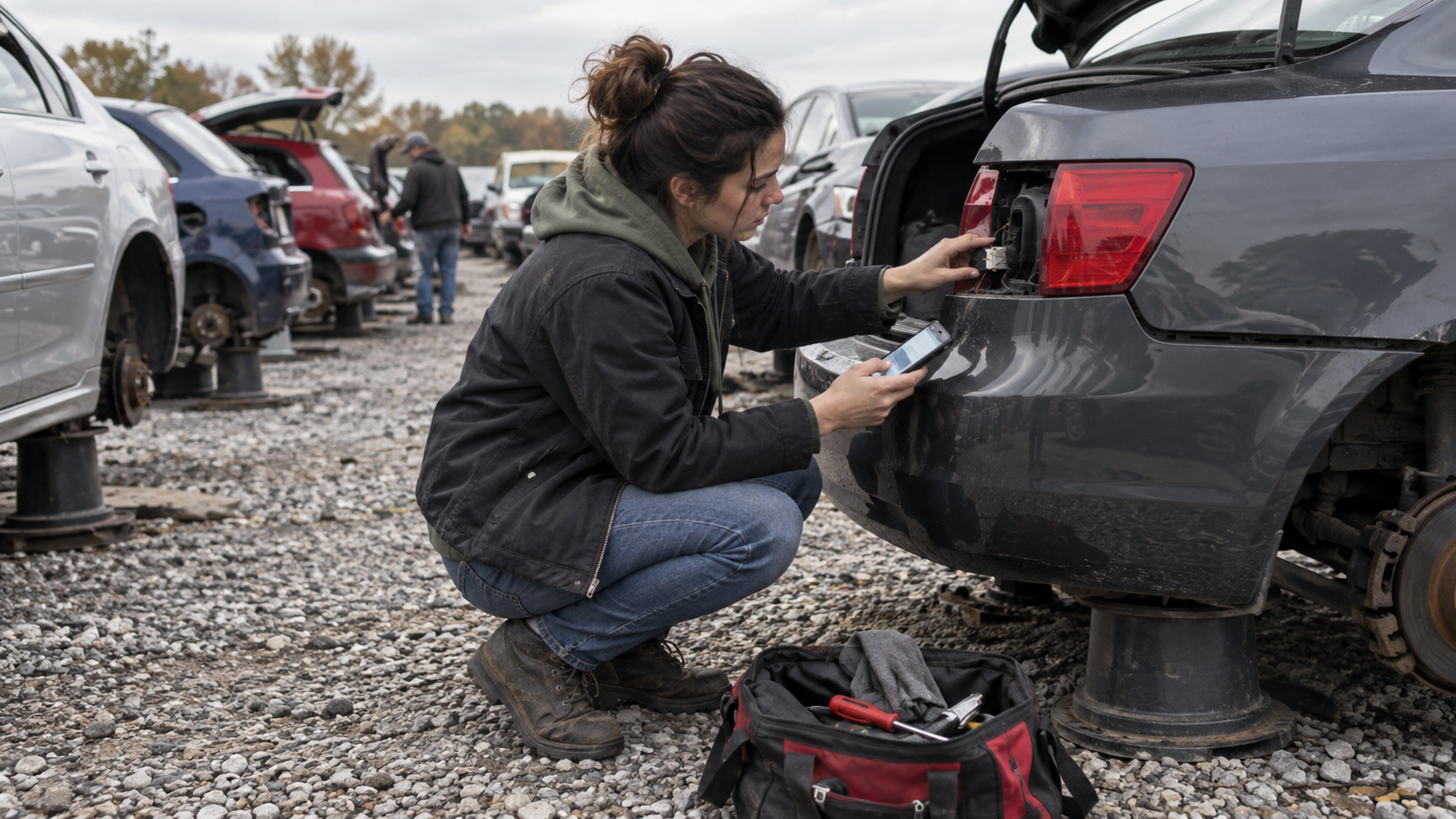
Used parts are how a lot of budget owners keep costs manageable on an older vehicle. At a self-service junkyard, you pull the part yourself from a donor vehicle, which generally costs less than a new replacement for common wear items and body pieces. Before you go, write down the year, make, model, trim, engine, and drivetrain, plus the part number or interchange information where it matters, and check current availability — yard inventory changes as vehicles come and go.
Putting it together: the buying sequence
- Look up your parish's combined tax rate, then add tax plus roughly $100 in fees to the asking price. That total is your real budget.
- Inspect the car cold, drive it at speed, scan it for codes, and run the VIN for branding and recalls.
- Have an independent mechanic inspect anything you're seriously considering.
- Verify the title: seller's name matches, VIN matches the vehicle, any lien released, odometer recorded.
- Meet at a notary, bank, or public tag agent and have the title assignment signed and notarized there.
- Get an original notarized bill of sale showing the actual price, unless the price is recorded in the title assignment.
- Take the packet, your photo ID, and proof of liability insurance to an OMV office or public tag agent — well inside the 40-day window.
Getting both halves right
Buying a cheap used car in Louisiana is really two separate jobs. The paperwork half is predictable: a notarized title assignment, form DPSMV 1799, ID, proof of insurance, and roughly $100 in fees plus parish tax, all completed within 40 days. Handle that in order and it's a single trip. The vehicle half is where patience pays — a cold start, a real test drive, a scan tool, and an hour of a mechanic's time will tell you more than any listing description.
If you're just beginning the search, it's worth looking at what's on hand locally before committing to a private-party deal, including used vehicles in the New Orleans area. Call ahead or check listings to confirm what's currently available, then apply the same inspection and title checks you'd use anywhere else. A cheap car that's been looked at carefully and titled correctly is a good deal. One that hasn't is just a cheap car.