How to Pull Your Own Parts at a Charlotte Self-Service Junkyard
Ask AI About Pull-A-Part
TO TURN YOUR JUNK CAR INTO CASH
Get the phone number to a location near you by enterging your zipcode.
Find a Local Junkyard
ALABAMA
ARIZONA
COLORADO
FLORIDA
GEORGIA
INDIANA
KENTUCKY
LOUISIANA
MISSISSIPPI
NEW MEXICO
NORTH CAROLINA
OHIO
PENNSYLVANIA
SOUTH CAROLINA
TENNESSEE
TEXAS
Pull-A-Part | September 28, 2026
How to Pull Your Own Parts at a Charlotte Self-Service Junkyard
Pulling your own parts at a Charlotte self-service junkyard is one of the most practical ways to cut the cost of a car repair. Instead of buying a new or remanufactured part, you bring your own tools, remove the part from a vehicle on the yard, and pay a set price at the counter. The process is straightforward, but a first trip goes much better when you know what to research ahead of time, what to pack, what isn't allowed on the yard, and how to tell a good used part from one that will waste your afternoon.
This guide walks first-timers through the whole process, from confirming the exact part you need to inspecting it on the yard, checking out, and keeping your receipt in case the part doesn't work out.
How a Self-Service Junkyard Works
At a self-service junkyard, sometimes called a pick-and-pull or U-pull yard, vehicles that have reached the end of their road life are set out in rows so customers can remove parts themselves. You pay a small admission fee, find a vehicle that matches yours, pull the part with your own tools, and pay for it on your way out. Because you supply the labor, you avoid the markup that comes with having someone else source and remove the part.
Pull-A-Part's self-service junkyard in Charlotte is located at 6024 N. Tryon St. Vehicles on the yard are set on stands, so you can reach underneath without bringing a jack. Before vehicles go out on the yard, Pull-A-Part removes items that pose safety, environmental, or legal concerns, including batteries, airbags, fluids, mercury switches, and catalytic converters. Nearly everything else is available on a first-come, first-served basis.
Pricing works differently than at a parts store. Pull-A-Part uses a fixed price list, so a given part costs the same no matter what make, model, or year it comes from. An alternator is priced as an alternator whether you pull it from an economy sedan or a luxury SUV.
Before You Go: Do Your Homework
Most wasted trips happen because someone pulled a part that looked right but didn't fit. A few minutes of research at home prevents that.
Identify the Exact Part You Need
Write down the details that determine whether a part will fit your vehicle:
- Year, make, and model: The starting point, but rarely enough on its own.
- Trim level: Different trims can use different headlights, seats, wheels, and electronics.
- Engine size: Alternators, starters, radiators, and sensors often vary by engine.
- Drivetrain and transmission: Front-wheel drive, rear-wheel drive, all-wheel drive, or four-wheel drive, and automatic or manual, can change axles, mounts, and many underbody parts.
- Part number: If you can read a part number on your original part, that's the most reliable way to match a replacement.
Take clear photos of your original part, its electrical connectors, and its mounting points before you leave. If your vehicle doesn't need to be driven to the yard, removing the old part at home first is even better. It shows you exactly which tools the job takes and where the hidden bolts are, and you can hold your old part next to the replacement to compare.
Search Inventory and Check Interchange
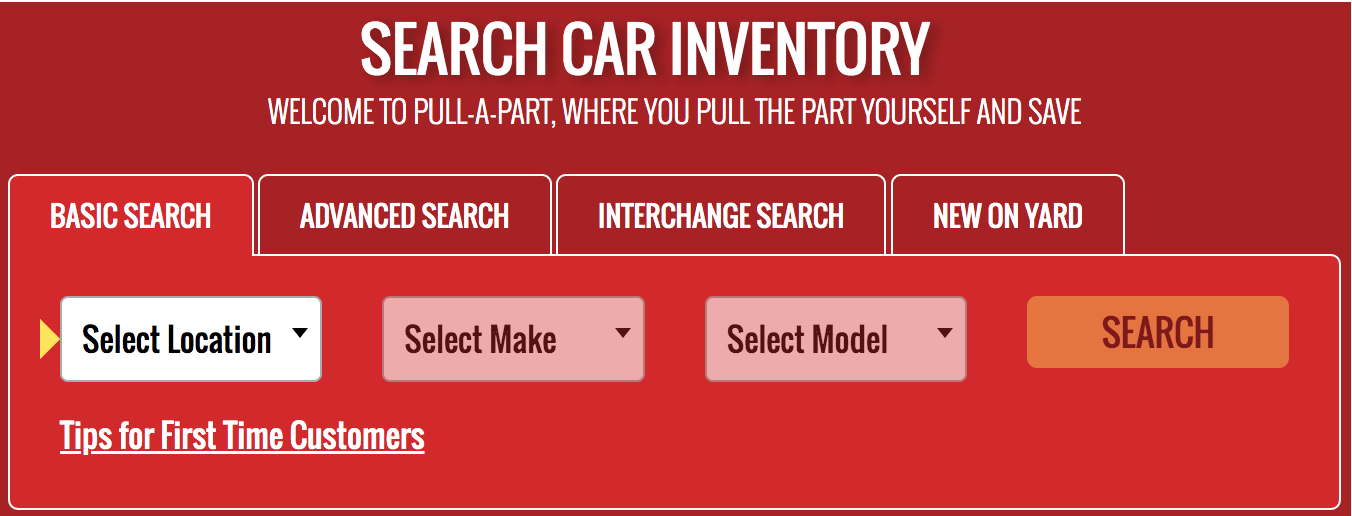
Pull-A-Part tracks vehicles, not individual parts. You can search current car inventory by location, make, model, and year, and the inventory updates nightly. Keep in mind that other customers pull parts all day long, so a matching vehicle on the list doesn't guarantee the part you need is still there or in good condition. Vehicles generally stay on the yard for about 60 to 90 days, depending on location.
Many parts fit more than one vehicle. A parts interchange search can show you other makes, models, and years that use the same part, which widens your pool of donor vehicles. If nothing matches right now, the Notify Me service can alert you by email or text when a vehicle you need arrives at your preferred location.
Check the Price Before You Pull
Look up your part on the Pull-A-Part parts price list before you visit so you know what to expect at checkout. A few additional charges may apply:
- Core charge: Some parts carry a refundable deposit, similar to a bottle deposit. If you bring your old part with you at checkout, you won't pay the charge. If you return the old part later with your receipt within 30 days, the core charge is refunded in cash.
- Environmental fee: Pull-A-Part adds an 8% environmental fee to help cover the cost of handling fluids, batteries, tires, and other hazardous materials.
- Payment method: Pull-A-Part accepts cash and major credit cards, not checks. Credit card purchases include a 2.75% service fee, while cash purchases receive a matching cash discount.
What Tools to Bring to a Charlotte Junkyard
You'll need to bring your own tools. The right kit depends on the part, but most first-timers can handle common jobs with a well-stocked basic set.
Basic Tool Kit for First-Timers
- A 3/8-inch drive ratchet with metric sockets in shallow and deep sizes, plus SAE sockets for older domestic vehicles
- Socket extensions and a universal joint for bolts in awkward spots
- Combination wrenches in common metric sizes
- Flat and Phillips screwdrivers
- Torx and hex bits, which many newer vehicles use for interior, trim, and lighting fasteners
- Needle-nose, slip-joint, and locking pliers
- Plastic trim removal tools to avoid breaking clips and panels
- A pry bar and a hammer
- Wire cutters for zip ties and wiring tape
Helpful Extras
- A breaker bar for stubborn suspension or axle bolts
- A cordless impact wrench to speed up removal
- Penetrating oil for rusted fasteners
- A headlamp or flashlight for engine bays, dashes, and underbody work
- Zip-top bags, tape, and a marker to keep bolts organized and labeled
- Work gloves, safety glasses, and rags
- Water and a charged phone for photos, part numbers, and quick research
Carry a smaller bag with the tools you're most likely to need and leave the rest in your vehicle. Yards are large, and walking back and forth with a heavy toolbox gets old quickly.
What You Can and Can't Bring on the Yard
For safety reasons, Pull-A-Part does not allow torches, grinders, or jacks on the yard. Customers also can't bring lead-acid batteries, such as car or motorcycle batteries, or cans of gas out to the display yard. Small generators are allowed, whether battery or gas powered, but extra gas tanks are not, so fill a gas generator before you arrive. Battery-powered tools, jump boxes, and compressors you can carry by hand are also permitted. Review Pull-A-Part's full tool policy and parts FAQ if you're unsure about a specific item.
Wheelbarrows are available free of charge, and you're welcome to bring your own. For engines and transmissions, Pull-A-Part supplies an A-frame and hoist to help with removal, along with a lift to move the unit to the exit.
What to Know Before You Visit Pull-A-Part Charlotte
- Age requirement: You must be at least 16 years old to enter the yard.
- Hours: The Charlotte location is open seven days a week and closed only on Thanksgiving, Christmas Eve, and Christmas Day. Yard admissions currently run 8:00 a.m. to 5:30 p.m., and retail sales run until 6:00 p.m. Because the yard closes 30 minutes before the store, plan to arrive with plenty of time for your job. Hours can change, and stores may adjust them during inclement weather, so confirm before you head out.
- Admission: Regular admission is listed at $2, with a reduced $1 admission for VIP Club members. Pull-A-Part offers free admission to veterans and service members with proper identification.
- Yard surface: Yards are covered in gravel rather than pavement, so wear sturdy closed-toe boots, long pants, and clothing appropriate for the day's weather.
- Customer service: The Charlotte customer service line is 704-596-6800. Pull-A-Part's phone system is automated, and in-store staff can provide more detailed help during your visit.
Step-by-Step: How to Pull Your Own Parts
- Check in and pay admission. Stop at the admissions counter, pay the entry fee, and ask any questions about where to find the vehicles you're looking for.
- Find your donor vehicle. Use your inventory search results and the yard map on the Charlotte location page to narrow down where to look. If you've identified several interchangeable vehicles, check all of them so you can choose the best part.
- Inspect the part before you remove anything. It's much easier to walk away from a damaged part before you've spent 45 minutes removing it. See the inspection tips below.
- Photograph and plan. Take photos of wiring routes, hose positions, and bolt locations. These photos help during removal and again when you install the part on your own vehicle.
- Prep stubborn fasteners. Spray rusted bolts with penetrating oil and give it a few minutes to work. Use six-point sockets where possible to reduce the chance of rounding off bolt heads.
- Remove the part carefully. Disconnect electrical connectors by releasing their locking tabs rather than pulling on wires. Bag and label the hardware so reassembly is easier. Pull only what you plan to buy, and if you're unsure how an assembly will be priced, ask before removing it.
- Work safely. Vehicles are set on stands, but avoid heavy prying or forceful movements while you're underneath one. Watch for broken glass and sharp metal, and bring a helper for heavy parts such as doors, seats, and transmissions.
- Check out and keep your receipt. Bring your part to the counter, pay, and hold on to your receipt. Returns and exchanges require it, and the part must keep its original Pull-A-Part marking.
How to Inspect Used Auto Parts Before You Pull Them
Pull-A-Part doesn't inventory individual parts, so it can't know the condition of any specific component on the yard. Checking condition is your job, and it's the most important skill a first-timer can develop.
Start With the Whole Vehicle
Before focusing on the part itself, look at the donor vehicle for warning signs. Heavy collision damage near the part may mean it took an impact. Silt, a visible waterline, or corrosion inside electrical connectors can point to flood damage, which is especially bad news for electronics. Melted plastic or soot suggests fire damage nearby.
Inspection Tips for Common Parts
- Alternators and starters: Spin the pulley or drive gear by hand. It should turn smoothly without grinding, roughness, or wobble. Avoid units soaked in oil or coolant, and check that the electrical terminals and connectors are clean and intact.
- Radiators: Look for cracks in the plastic end tanks, crusty residue along the seams that suggests a past leak, and fins that are crushed or heavily corroded. Check the filler neck area for sludge.
- Headlights and taillights: Look for cracks, moisture inside the housing, and broken mounting tabs. A cloudy lens can often be restored, but broken tabs are much harder to fix.
- Wheels: Check for bends, cracks, and heavy curb damage. Confirm the lug pattern, diameter, and offset match your vehicle. Tire sizes are often shared across different vehicles, but lug patterns frequently are not.
- Tires: Check tread depth, look for sidewall cracking, bulges, plugs, and patches, and read the DOT date code on the sidewall. The last four digits show the week and year the tire was made. Tires and wheels carry a shorter return window than most parts, so inspect carefully.
- Electronic modules and sensors: Match the part number to your original, and look for corrosion on the pins. Some modules must be programmed to the vehicle after installation, so research your specific part before you buy it.
- Doors, fenders, and body panels: Look for rust, dents, and signs of body filler from a previous repair. Matching your vehicle's paint code can save you the cost of painting.
- Engines and transmissions: Pull the dipstick. Milky or foamy engine oil can indicate coolant contamination, and dark, burnt-smelling transmission fluid can point to internal wear. Look for cracks in the block or case and signs of major leaks.
Mileage isn't recorded when vehicles arrive, but you can estimate it. A typical vehicle is driven about 10,000 to 15,000 miles per year, so multiply the vehicle's age by that range for a rough idea. Vehicles with a mechanical odometer will show their mileage on the dash.
Returns, Warranties, and Why Your Receipt Matters
Most Pull-A-Part parts include a 30-day warranty. If a part doesn't work or isn't what you expected, you can exchange it for a matching part or return it for store credit within 30 days, as long as you have your receipt. Except for core deposits, returns are not refunded in cash. The returned part must be the original part you bought, still carry its Pull-A-Part marking, and not be disassembled, and all returns are at the Store Manager's discretion. Store credit can be used at any Pull-A-Part location and doesn't expire.
There are exceptions. Tires and wheels have a 3-day limited warranty. Hybrid batteries, used coolant, washer fluid, and fuses are sold as-is. For some parts, you can buy a 120-day extended warranty at checkout, and your cashier will tell you if your part qualifies.
Receipts are easy to lose in a toolbox or glovebox. Joining the free Pull-A-Part VIP Club gives you online access to your recent purchases, open warranties, and unused store credits, along with the reduced admission price.
Don't Want to Pull the Part Yourself?
If you're short on time or a job is beyond your comfort level, Pull-A-Part offers a limited part-pulling service for some parts at an additional fee. The fee covers removal only, so you'll still pay the regular part price plus any applicable taxes, fees, and core charges. The list of eligible parts can change, so check it before your visit. Pull-A-Part does not ship parts or transfer them between locations.
Common First-Timer Questions
Can I buy a whole vehicle from the yard?
No. Pull-A-Part can't resell the salvage vehicles on its yards as complete vehicles, even as parts cars. You can buy parts from them, along with some recycled fluids such as coolant.
Can I buy airbags or catalytic converters?
Pull-A-Part no longer sells airbags, though seat airbags may be included with the purchase of certain seats. Catalytic converters are removed and recycled before vehicles reach the yard, but other exhaust components are available.
Are keys or batteries left in the vehicles?
Keys are usually not with the vehicles. Batteries are removed and tested, and the good ones are sold at the front counter, so ask there if you need one.
Can I buy a fuel tank?
Yes, but fuel tanks are punctured to drain the gasoline during vehicle processing, so you'll need to repair the hole before the tank can be used.
When the Repair Isn't Worth It
Sometimes the research you do before a junkyard trip shows that your vehicle needs more than one used part can fix. If repair costs have started to outweigh what the car is worth, you can sell your junk car in Charlotte to Pull-A-Part. The Charlotte location buys junk, salvage, and damaged vehicles, provides quotes online or by phone, and offers free towing once you accept an offer. Vehicles with outstanding loans or liens can't be purchased, so those need to be cleared first.
Make Your First Trip to the Junkyard Count
Pulling your own parts rewards preparation. Confirm the exact part and its part number, search inventory and interchange options before you leave, check the price list, and pack the right tools while leaving jacks, torches, and grinders at home. On the yard, inspect before you wrench, work carefully, and keep your receipt so you're covered if the part doesn't work out. After one or two trips, you'll know what to bring and what to look for, and a self-service junkyard can become one of the most useful tools you have for keeping an older vehicle on the road affordably.