Buying a Cheap Used Car in Ohio: Title, Registration, and Fees
Ask AI About Pull-A-Part
TO TURN YOUR JUNK CAR INTO CASH
Get the phone number to a location near you by enterging your zipcode.
Find a Local Junkyard
ALABAMA
ARIZONA
COLORADO
FLORIDA
GEORGIA
INDIANA
KENTUCKY
LOUISIANA
MISSISSIPPI
NEW MEXICO
NORTH CAROLINA
OHIO
PENNSYLVANIA
SOUTH CAROLINA
TENNESSEE
TEXAS
Pull-A-Part | September 8, 2026
Buying a Cheap Used Car in Ohio: Title, Registration, and Fees
A $2,000 car in Ohio does not cost $2,000. Before you can legally drive it, you will owe sales tax on the purchase price, a title fee at a county Clerk of Courts title office, and registration charges at a BMV deputy registrar. The clock starts the day of the sale, too: Ohio gives you 30 days from the date of sale to get the vehicle titled in your name before a late fee is added.
The detail that catches first-time buyers is that Ohio splits the job between two offices. The county Clerk of Courts issues the title and collects the sales tax. The Ohio BMV issues the plates and the registration. Do those out of order, or show up missing a document, and you are making a second trip.
Here is what buying a used car in Ohio actually costs beyond the sale price, the order the paperwork has to happen in, the emissions rule that applies in seven counties, and what to look at on a low-priced car before any money changes hands.
How a used-car purchase works in Ohio, start to finish
Whether you buy from a neighbor, a small lot, or a yard that sells whole vehicles, the sequence is the same.
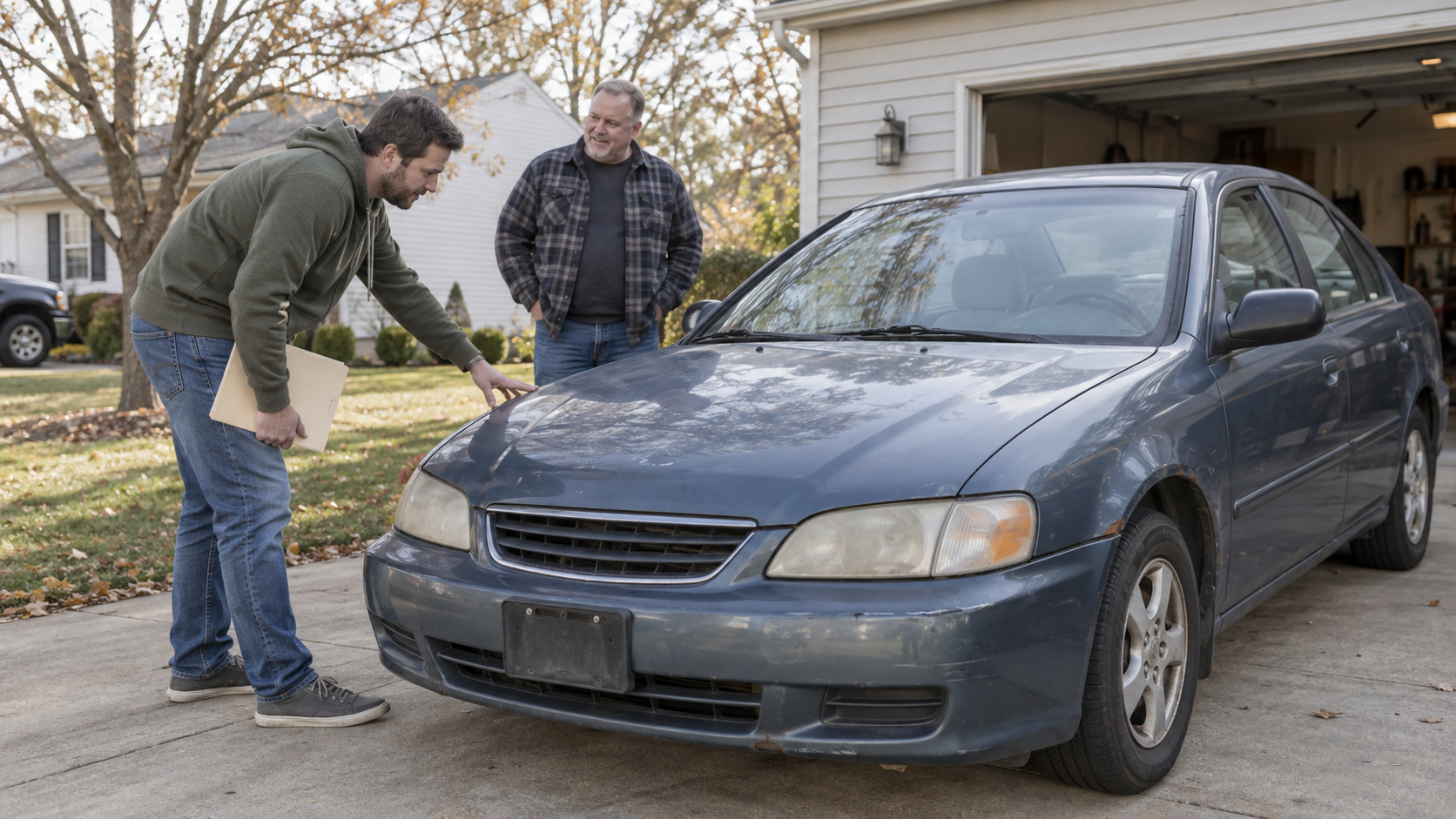
- Inspect the car and the title together. Check that the VIN on the vehicle matches the VIN on the title, that the seller's name matches their photo ID, and that no lien is still showing on the title record.
- Have the seller assign the title in front of a notary. Ohio requires the seller's signature on the assignment of ownership to be notarized. If the title is held electronically, the seller instead completes and notarizes the Ownership Assignment and Title Application for Casual Sale (form BMV 3770). The Ohio BMV's titling instructions cover both situations, including what to do when a lienholder still holds the paper title.
- Take the assigned title to a county Clerk of Courts title office. Bring acceptable photo identification, your Social Security number, payment for the title fee, and the sales tax. Photocopies of a title are not accepted, and if two people are named as owners on the assignment, both generally need to be present unless there is a notarized power of attorney.
- Get an E-Check if you live in one of the seven testing counties and the vehicle is due for one. More on that below.
- Register the vehicle and get plates at a BMV deputy registrar. You will need the Ohio certificate of title or memorandum of title, your Ohio driver license or state ID, and you will sign a financial responsibility statement confirming you carry insurance. The BMV lists the full document requirements on its new registration page.
- Insure the car before you drive it. Ohio's financial responsibility law applies from the moment the vehicle is on the road, not from the moment your plates arrive.
The simplest version of all this is for buyer and seller to meet at the title office. Deputy clerks can notarize the assignment on the spot, which removes the most common failure point in a private sale.
What buying a used car in Ohio costs beyond the sale price
For a typical passenger car, the government charges usually land somewhere around $60 to $95 before sales tax, depending on your county. Sales tax is the bigger variable, and it is the one people forget to set aside cash for.
Sales tax
Ohio's state rate on a vehicle purchase is 5.75%, and your county adds its own rate on top. The tax is calculated at the rate in effect in the county where you live, not where the car was sitting, and you pay it to the clerk when the title is transferred rather than to the seller.
Private sales are not exempt. Ohio law specifically pulls motor vehicles out of the casual-sale exemption, so a car bought from a co-worker is taxed the same way one bought from a dealership is. Sales between family members are taxable too, as long as money or anything else of value changed hands.
Two things regularly surprise budget buyers. First, a trade-in allowance only reduces the taxable price when you are buying a new vehicle. Trade a car in on a used one and you still owe tax on the full price. Second, the Ohio Department of Taxation audits casual-sale title transfers and mails letters to buyers and sellers when a reported price looks low for the vehicle. Writing a smaller number on the title to shave $40 off the tax is a bad trade: the department can bill you for the difference, and misrepresenting the price is a criminal offense under Ohio law. The Department of Taxation's motor vehicle tax page explains how the taxable price is figured, including trades, gifts, and loan assumptions.
Title fees
The certificate of title fee is $18 statewide, and some counties charge $23 where local officials have approved an additional amount. Budget up to $5 more if you need a notary, and another $8 if the car is coming in on an out-of-state title, which requires a VIN inspection before Ohio will issue a title. Those inspections are available at deputy registrar agencies, participating title offices, and some licensed Ohio dealerships.
Miss the 30-day window and a late fee is added on top. Current amounts for all of these are posted on the Ohio BMV fee schedule, which is worth checking before you go since fees are updated periodically.
Registration, plates, and the fuel-type fee
Annual registration for a passenger vehicle is $36, plus an $8 deputy registrar fee for a one-year registration, plus your local permissive tax. Permissive tax is a local charge assessed in $5 increments based on your taxing district and capped at $30 per vehicle, which is why two people paying the same $36 base fee can walk out with noticeably different totals.
If you already own a vehicle, transferring the registration and plate to your newly purchased car costs $9. Plates in Ohio stay with the owner rather than the car, so a private seller keeps theirs, and you will need either a plate you already have or a new one. If you need to drive the car before the title is transferred, a 45-day temporary tag is $23, and it has to be obtained before the Ohio title is issued in your name. Once you hold an Ohio title, you can only buy permanent plates.
One line item worth checking before you fall for a bargain hybrid: Ohio charges an additional annual fuel-type fee of $100 for a hybrid, $150 for a plug-in hybrid, and $200 for an electric vehicle, applied to model year 2009 and newer. On a car you paid $3,000 for, that fee can be a meaningful share of what it costs you to keep it on the road each year.
E-Check: the emissions rule in seven Ohio counties
Ohio does not test emissions statewide. E-Check applies to vehicles registered in Cuyahoga, Geauga, Lake, Lorain, Medina, Portage, and Summit counties. Gasoline and diesel vehicles are tested every two years starting at about six model years old, and non-plug-in hybrids starting at about seven, until they age out of the program. Vehicles rated over 10,000 pounds GVWR are outside it.
This matters specifically to used-car buyers because a title transfer can trigger a test. If you buy a car in one of those seven counties and its emissions test has expired or the vehicle has never been tested, it will need to pass before you can complete your registration.
Two practical moves follow from that. Ask the seller whether the car has a current passing E-Check, since a passing certificate is good for 365 days and carries over to the new owner. And take a check-engine light seriously: testing is now an OBD-II computer scan, so an illuminated light generally means a failed test, and the repairs become your problem, not the seller's. Ohio does offer a repair waiver if you spend enough on qualifying repairs and diagnostics without passing, and that minimum rose to $450 as of January 1, 2026. Current rules, station locations, and exemption details are on the Ohio EPA E-Check page.
Read the title before you hand over cash
On an inexpensive car, the title is where most of the real risk lives. Look at four things.
- Whose name is on it. The person selling you the car should be the person named on the title. If the seller's name is not on it and they are handing you a title signed by someone else, walk away. That is title jumping, and you will not be able to register the car.
- Whether it is signed already. A title that has been signed but not notarized in front of you is a problem, and a pre-signed title with blank buyer fields is a bigger one. Ohio's notarization requirement exists to prevent exactly this.
- Whether a lien is showing. If a lender still has an interest in the vehicle, you need the lien release before the clerk will issue a clean title in your name.
- Whether the title is branded. Look for salvage, rebuilt salvage, non-actual mileage, or similar notations. A repaired salvage vehicle has to pass an Ohio State Highway Patrol inspection before it can be titled as rebuilt salvage, and a branded title follows the car permanently. That is not automatically a reason to say no, but it should be reflected in the price, and you should confirm with your insurer what coverage is available before you buy.
Also check the odometer disclosure on the assignment. If the mileage on the title does not match the dash, ask why before you pay.
What to check on a cheap car before you buy
Ohio's registration process does not include a safety inspection for ordinary passenger cars. Nothing at the title office or the deputy registrar is checking whether the car is mechanically sound, so that job belongs entirely to you.
- Start it cold. Ask the seller not to warm the car up before you arrive. Hard starting, blue or white exhaust, and noises that fade after a few minutes are much easier to catch on a cold engine.
- Get underneath it. In a state that salts its roads all winter, rust is what ends most cheap cars. Check rocker panels, subframe mounts, strut towers, and especially brake and fuel lines. Surface rust on a floor pan is survivable; crumbling structure and weeping brake lines are not.
- Check the fluids. Milky or foamy oil, coolant that is low with no obvious leak, and burnt-smelling transmission fluid all point to repairs that can easily exceed what you are paying for the car.
- Scan for codes. An inexpensive code reader, or a free scan at a parts store, tells you what the car's computer has already recorded. This is the cheapest thirty seconds of research in the whole process.
- Drive it at highway speed. A lap around the block hides vibration, pulling, transmission slip, and overheating. Get it to 60 mph if you can do so safely.
- Pay for a pre-purchase inspection. An hour of an independent mechanic's time usually costs far less than the first repair you would otherwise inherit blind.
Then do the math honestly. A running car with a known $1,200 repair ahead of it is a $1,200-more-expensive car, and on a budget purchase that can be the difference between a good deal and a money pit.
Where to look for an affordable used car in Ohio
Budget shoppers generally have three sources: private sellers, small independent lots, and salvage yards that sell whole vehicles rather than parting everything out. Each has trade-offs. Private sales usually carry the lowest price and the least recourse. Lots handle more paperwork but build that into the price. Yards that sell cars tend to price around condition and mechanical uncertainty, which can work in your favor if you are comfortable turning wrenches.
Pull-A-Part sells vehicles at its Ohio yards and lists what is on the lot online, so you can look through affordable used cars in Akron, budget-friendly used cars in Canton, or inexpensive used vehicles in Cleveland West before making the drive. Inventory turns over constantly, so check current listings rather than assuming a specific car is still available. And keep expectations calibrated: an affordable vehicle is a vehicle priced for its condition, not one guaranteed to be trouble-free or right for every driver.
Wherever you buy, the state-level steps do not change. You still need a properly assigned title, you still owe the sales tax at the clerk's window, and the 30-day clock still applies.
Keeping a budget car on the road, and knowing when to stop
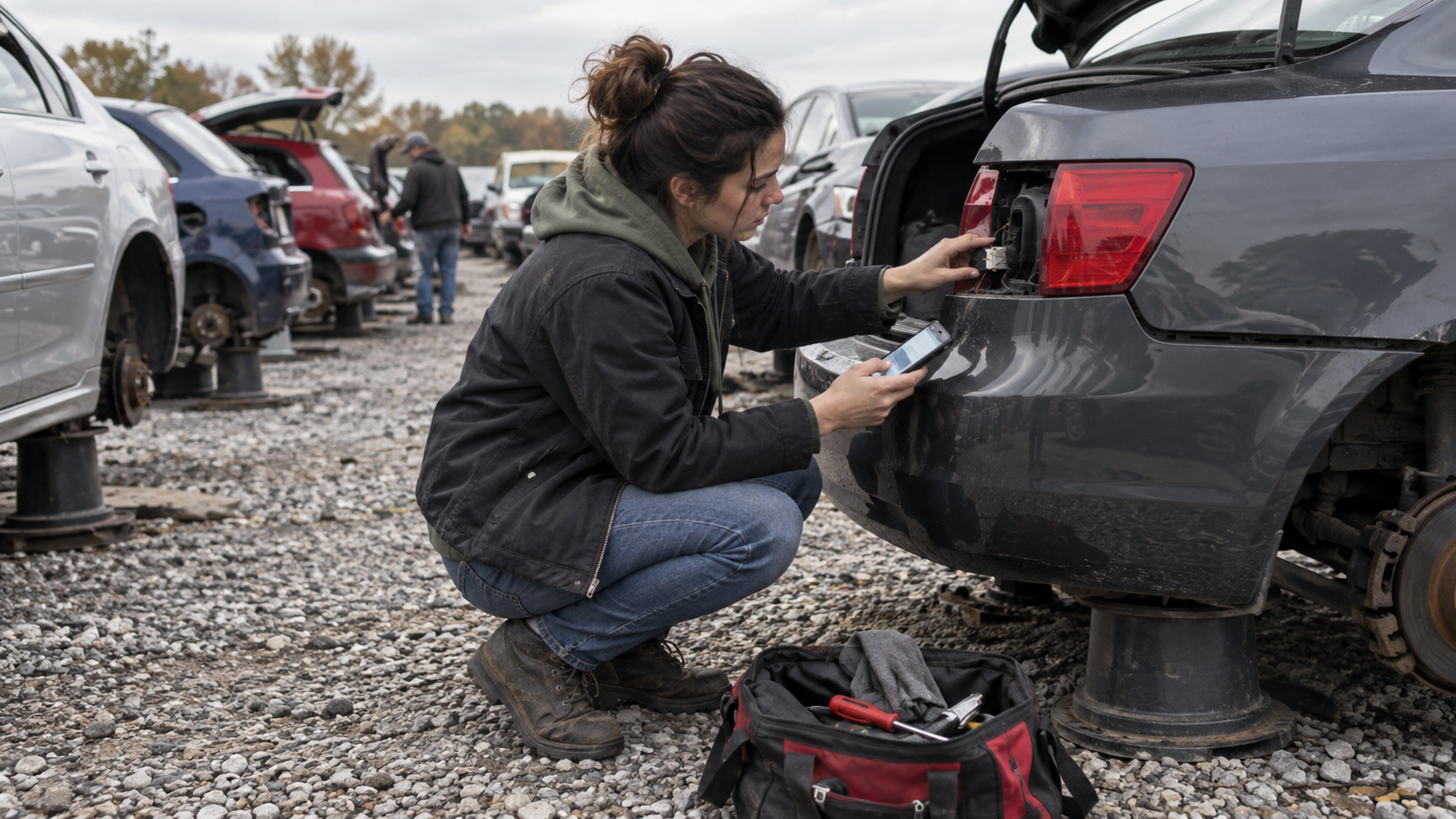
The economics of a cheap car depend almost entirely on what repairs cost you. Buying used parts is one of the most direct ways to hold that number down, particularly for body panels, mirrors, wheels, interior pieces, alternators, and other components where a good used part does the same job as a new one. A self-service junkyard lets you pull parts yourself, which cuts labor out of the equation entirely.
When you shop for a used part, match more than the model name. Confirm year, make, model, trim, engine, and drivetrain, and use the part number from your old component when you can. Parts that look identical across two model years often are not, and interchange information is what separates a successful trip from a wasted afternoon.
Eventually every budget car reaches the point where the next repair costs more than the vehicle is worth. When that happens, an old or non-running car still has value in its parts and metal, and you can sell an unwanted vehicle for cash and roll that money into the next one. Just handle the paperwork on the way out the same way you did on the way in: sign the title correctly, take your plates off, and cancel the registration and insurance so you are not carrying costs on a car you no longer own.
The bottom line for Ohio budget buyers
The mechanics of buying a used car in Ohio are not complicated, but they are unforgiving of shortcuts. Get the title assigned and notarized correctly, bring cash for the sales tax and title fee to the Clerk of Courts, handle E-Check if your county requires it, and register at a deputy registrar inside 30 days. Set aside sales tax plus roughly $60 to $95 in title and registration charges on top of the purchase price, and more if the car is a hybrid or an EV.
Rules and fees change, and individual situations vary, so confirm current requirements with the Ohio BMV, your county Clerk of Courts title office, and the Ohio Department of Taxation before you finalize a purchase. Do that groundwork first, and the cheap car you found stays cheap.