What are the Most Common Vehicles in Louisiana Junkyards?
Ask AI About Pull-A-Part
TO TURN YOUR JUNK CAR INTO CASH
Get the phone number to a location near you by enterging your zipcode.
Find a Local Junkyard
ALABAMA
ARIZONA
COLORADO
FLORIDA
GEORGIA
INDIANA
KENTUCKY
LOUISIANA
MISSISSIPPI
NEW MEXICO
NORTH CAROLINA
OHIO
PENNSYLVANIA
SOUTH CAROLINA
TENNESSEE
TEXAS
Pull-A-Part | August 3, 2026
The Most Common Vehicles in Louisiana Junkyards: A DIY Parts Guide
If you are heading to a self-service yard in Baton Rouge, Lafayette or the New Orleans area, the vehicles most likely to be waiting in the rows are the ones that sold in the biggest numbers here and stayed on the road the longest: full-size domestic pickups, midsize and compact Japanese sedans, high-volume domestic sedans, and the crossovers, SUVs and minivans that replaced them. Knowing which platforms run deep tells you which repairs are realistic to source used and which ones will take patience.
What no list can tell you is what is actually on the yard the day you show up. Vehicles at Pull-A-Part are generally out for roughly 60 to 90 days depending on the location, new arrivals are set out almost daily, and the online inventory is refreshed each night. So treat the patterns below as odds, not guarantees. This guide covers which vehicle families tend to be plentiful, which parts are worth pulling from them, and how to pin down fitment by year, make, model, trim and engine before you drive out.
Why the same vehicles keep turning up in Louisiana salvage yards
A self-service yard's inventory is a delayed snapshot of what local drivers bought and kept. Pull-A-Part buys vehicles in any condition directly from the public, so when a driver decides it is finally time to sell an old or non-running vehicle, that car may become the donor someone else pulls a fender or an alternator from a few weeks later. The mix in the rows mirrors the local vehicle population more than it reflects any particular buying decision.
Two factors decide whether a model is easy or hard to source used. The first is raw sales volume: a nameplate that moved hundreds of thousands of units a year gives you many donor cars. The second is production run length: a platform that went eight or ten years without a major redesign means one part often covers many model years, which is the whole basis of shopping self-service used auto parts efficiently.
Age matters too. S&P Global Mobility puts the average age of light vehicles in the U.S. at about 12.8 years, with passenger cars averaging closer to 14.5 years. That is why a walk down the rows usually turns up a lot of mid-2000s through mid-2010s metal, alongside a smaller number of newer vehicles that arrived after a collision.
Vehicle families you are most likely to find in Louisiana junkyards
The groupings below reflect the platforms that consistently make up the bulk of self-service inventory across the region. They are a guide to your odds, not a statement of current stock at any yard.
Full-size domestic pickups
Full-size trucks have been the best-selling vehicles in the country for decades, and that volume shows up downstream. The Ford F-150, Chevrolet Silverado and GMC Sierra, and Dodge and Ram 1500 anchor this category, with older Ford Rangers, Chevrolet S-10s and Colorados, and Dodge Dakotas covering the compact side. Long production runs are the advantage here: a bed side, door, mirror or interior panel often carries across several model years, so a picked-over donor truck is not the end of the search.
Midsize import sedans
The Nissan Altima, Toyota Camry and Honda Accord are the workhorses of this group. Registration studies have ranked the Altima among the most commonly driven cars in Louisiana and neighboring Gulf South states, and Camrys and Accords are close behind almost everywhere. These platforms also tend to give you the widest interchange window, since the same alternator, starter, window regulator or headlight assembly can span multiple model years and sometimes multiple models.
Compact and economy cars
Honda Civics, Toyota Corollas, Nissan Sentras, Hyundai Elantras, Chevrolet Cruzes and Ford Focuses arrive steadily. Because they are inexpensive to keep running, they are also the cars owners most often repair themselves, which means popular donors get stripped of the easy parts quickly. If a compact you need shows up as a recent arrival, go sooner rather than later.
Domestic sedans and full-size cars
Chevrolet Impalas and Malibus, Ford Taurus and Fusion sedans, the Ford Crown Victoria and Mercury Grand Marquis, and older Pontiac and Buick sedans remain common. Heavy fleet use plus long production runs created deep parts commonality across GM and Ford lines, which pays off when you use an interchange lookup instead of searching one model at a time.
Crossovers, SUVs and minivans
This category keeps growing. Expect Ford Explorers and Escapes, Chevrolet Equinoxes and Trailblazers, Jeep Grand Cherokees and Libertys, Nissan Rogues, Honda CR-Vs, Toyota RAV4s, and Dodge Grand Caravan and Chrysler Town & Country minivans. The number of passenger cars on U.S. roads recently fell below 100 million for the first time since the 1970s as buyers shifted toward light trucks and utilities, and salvage inventory follows that same curve a decade behind.
European luxury models, newer vehicles and low-volume trims do turn up, but in smaller numbers and usually for less time. If you drive something uncommon, an interchange search and an inventory alert will do far more for you than showing up and hoping.
Which parts are worth pulling from high-volume platforms
Pull-A-Part prices parts by type rather than by vehicle, so the same part costs the same whether it came out of an economy sedan or a luxury car. That changes the math on what is worth your time. The best candidates are parts that are expensive new, hold up well used, and come off with hand tools.
Body panels, glass, lighting and wheels
Doors, fenders, hoods, deck lids, bumper covers, mirrors, headlight and taillight assemblies, grilles, moldings and wheels are among the strongest values on any high-volume platform, because new equivalents are costly and used ones either fit or they don't. Painted panels need a color match, and the online inventory does not list exterior color or interior type, so panel and trim shopping is done with your own eyes once you are on the yard.
Interior pieces and small hard-to-find parts
Seats, door panels, center consoles, switches, window regulators, sun visors, glove box latches, and the clips, brackets, fasteners and connector pigtails that no one stocks anymore. On a fifteen-year-old car, a broken trim clip or a cracked interior panel is often the only thing standing between you and a finished repair, and a common platform is the one place you can reasonably expect to find a spare.
Mechanical and electrical parts
Alternators, starters, A/C compressors and condensers, radiators, cooling fans, power steering pumps, throttle bodies, ignition coils, intake manifolds, sensors, brake calipers, CV axles, and engines and transmissions for larger projects. Some parts carry a core charge and an environmental fee is added at checkout, so it is worth reviewing the published parts price list before you plan a budget. Odometer readings are not recorded when vehicles arrive, so judge wear items on inspection rather than on assumed mileage.
What you will not find on the yard
- Catalytic converters are removed during vehicle processing and are not sold at any Pull-A-Part location.
- Driver and front passenger airbags and related airbag components are not resold, with the exception of horn covers.
- Batteries, fluids and mercury switches are pulled before a vehicle goes out, and A/C refrigerant is evacuated during processing.
- Tire carcasses are treated as unfit for road use, so do not plan a trip around finding usable tires.
Use your own judgment on safety-critical items with unknown history. Brake hoses, seat belt assemblies from a vehicle that may have been in a collision, and timing components are generally better bought new.
How to confirm fitment before you drive out
Most wasted trips come down to one missed detail. Work through this before you leave the house.
- Write down the full specification of the vehicle you are repairing: year, make, model, trim, engine displacement or engine code, transmission, drivetrain and body style. On platforms that offered two or three engines and both front- and all-wheel drive, "same model, same year" is not enough.
- Confirm that specification against the VIN rather than the badge on the trunk lid. NHTSA's free vPIC VIN Decoder returns manufacturer-reported details such as body class, engine configuration, displacement and drive type for model year 1981 and newer vehicles.
- Get a part number off the old part whenever you can, whether that is a molded or stamped OEM number, a supplier label or a casting number. Photograph it along with the connector and the mounting points.
- Run an interchange lookup before you assume you are out of luck. Manufacturers share parts across models, brands and model years, and what you need may be sitting on a vehicle you would never have thought to check.
- Review the vehicle listing when you search the current vehicle inventory. Engine, transmission and body style are shown for many vehicles, though not all, and interior type and exterior color are not listed at all.
- Bring the old part with you when it is practical. Comparing bolt patterns, connector pin counts, bracket tabs and sensor placement side by side in the row beats measuring from memory.
Mid-cycle changes are what catch experienced DIYers out. A facelift, a revised connector, a different sensor supplier or an early-versus-late production split within a single model year can all break compatibility, and body and electrical parts are the most sensitive to it. For electronic modules, keys and some infotainment units, expect that programming or immobilizer matching may be required, and confirm that before you count on a used unit.
Checking inventory at Louisiana's three Pull-A-Part yards
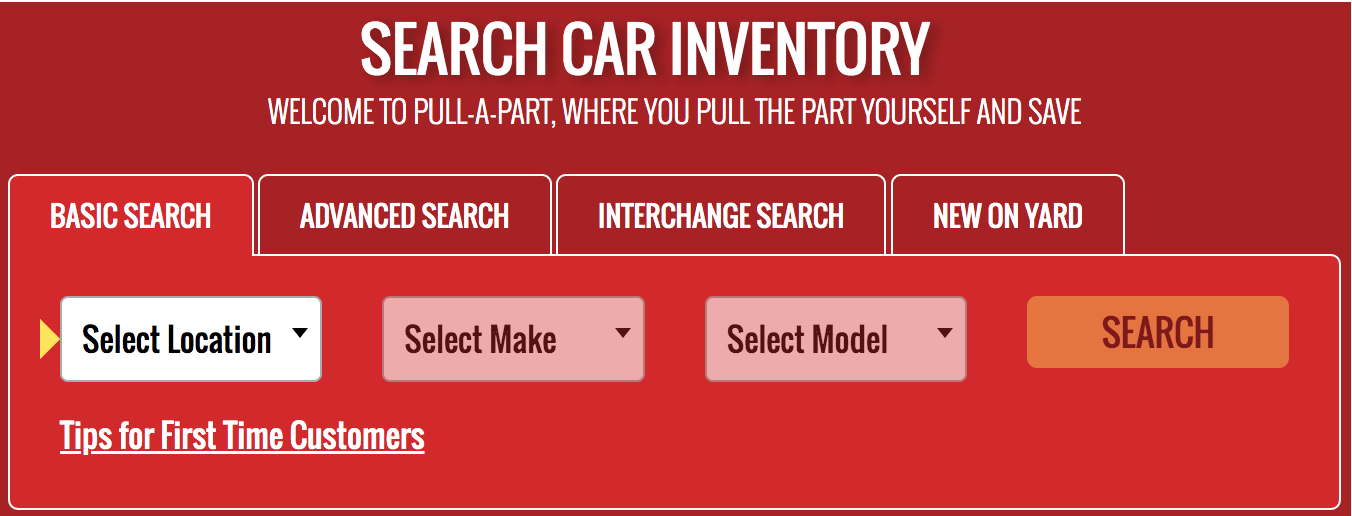
Each location maintains its own inventory database, and the three Louisiana yards do not share stock. If you are willing to drive, the advanced search lets you check multiple locations, years and models at once, which is often faster than waiting for the right car to land at the yard nearest you.
In the capital area, the Baton Rouge junkyard on Greenwell Springs Road is the closest option for drivers coming from the north and east side of the metro. To the west, the Lafayette self-service yard on Galbert Road serves Acadiana. And on the south shore, the New Orleans West salvage yard on Peters Road covers the greater New Orleans area. All three publish current hours, admission details and a yard map on their location pages, which is worth a look before a first visit.
If the vehicle you need is not listed today, two free tools are worth using before you make the drive. The New On Yard list shows what has been set out in the past 24 hours, 48 hours or seven days at the locations you pick, and a Notify Me alert will text or email you when a matching year, make and model arrives. On a common platform, the wait is often short.
What to bring and what to expect on the yard
- Your own hand tools. Jacks and torches are not permitted, so plan your approach around that before you go.
- A breaker bar, penetrating oil, and extra sockets and extensions. Humidity is hard on fasteners in this part of the country, and a seized bolt is the most common reason a quick pull turns into a two-hour job.
- Gloves, eye protection, closed shoes and something to kneel on.
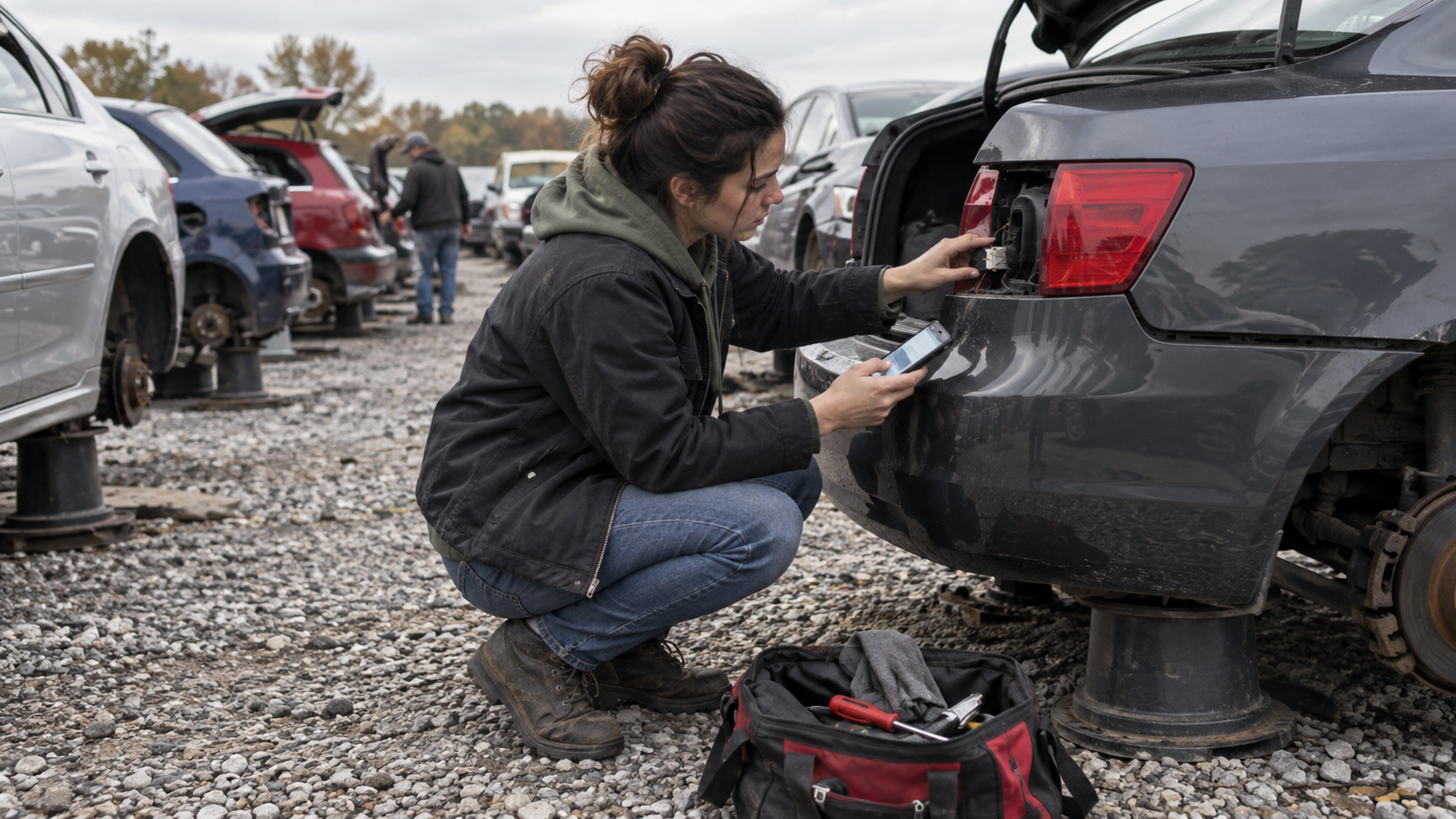
- A phone for photographing part numbers, connector routing and bolt locations before you disconnect anything.
- Payment for the small admission fee. You must be at least 16 to enter the yard at these locations.
One habit is worth building anywhere, and especially in a low-lying region that sees heavy rain: check for signs of water intrusion before you pull anything electrical. Silt in the carpet or the spare tire well, a waterline on the lower door trim, greenish corrosion on connector pins or a musty interior are all good reasons to leave a module, harness or motor alone and find another donor. Body panels and mechanical hardware are more forgiving. Electronics are not.
If a particular part is more than you want to tackle, some locations will pull certain parts for a fee. Availability varies by store and by part, so ask at the counter rather than assuming.
The bottom line for Louisiana DIYers
The vehicles filling the rows today are the ones that filled driveways here ten to twenty years ago, which is good news if you drive a common truck, sedan or crossover and a reason to plan ahead if you don't. Volume gives you more donors, wider interchange and better odds that the specific bracket, panel or sensor you need is still attached to something. What it does not give you is certainty. Pin down the year, make, model, trim, engine and drivetrain first, check what is actually on the yard the day you go, and take the old part along for comparison. That combination is what turns a trip to the yard into a finished repair instead of a second trip.