
The Most Common Vehicles in Ohio Junkyards: A DIY Parts Guide
Ask AI About Pull-A-Part
TO TURN YOUR JUNK CAR INTO CASH
Get the phone number to a location near you by enterging your zipcode.
Find a Local Junkyard
ALABAMA
ARIZONA
COLORADO
FLORIDA
GEORGIA
INDIANA
KENTUCKY
LOUISIANA
MISSISSIPPI
NEW MEXICO
NORTH CAROLINA
OHIO
PENNSYLVANIA
SOUTH CAROLINA
TENNESSEE
TEXAS
Pull-A-Part | September 15, 2026
The Most Common Vehicles in Ohio Junkyards: A DIY Parts Guide
If you're heading to a self-service yard to fix your own car, it helps to know what you'll probably find before you pay admission and haul your tools across the gravel. The short answer: the most common vehicles in Ohio junkyards are the ones drivers bought in large numbers 10 to 20 years ago. That means lots of midsize and compact sedans, full-size pickups, compact SUVs, and minivans from the major domestic and Japanese brands.
The exact mix changes every day, so no list can replace a current inventory check. What this guide does is explain which types of vehicles tend to be plentiful, which used parts are worth pulling from them, which parts to skip or inspect closely in Ohio's rust-prone climate, and how to plan a productive trip to a Pull-A-Part yard in Akron, Canton, or Cleveland West.
Why Certain Vehicles Show Up in Ohio Junkyards So Often
Salvage yards fill up with whatever drivers retire, so the vehicles you see most are usually the ones that sold well and have now reached the end of their working lives. Americans are keeping vehicles longer than ever. S&P Global Mobility's 2025 analysis put the average age of U.S. cars and light trucks at a record 12.8 years, with passenger cars averaging 14.5 years. When a high-volume model reaches that age range, a steady stream of them starts arriving at salvage yards.
A few other factors shape what ends up on the rows:
- Expensive mechanical failures. A failed transmission or engine can cost more to repair than an older vehicle is worth, so the owner sells it instead. The rest of the car may still be in usable shape.
- Collision damage. A wrecked vehicle often has undamaged parts on the side or end that didn't take the hit.
- Rust and corrosion. Ohio road crews rely heavily on salt and brine to keep winter roads passable, and that salt speeds up corrosion on brake lines, rocker panels, frames, and subframes. Some vehicles are retired mainly because of underbody rust, even when their engines, interiors, and electrical parts still work.
Turnover is also fast. According to Pull-A-Part, vehicles generally stay on the yard for about 60 to 90 days, depending on the location, and parts are sold on a first-come, first-served basis. A vehicle that appears in the inventory today may already be missing the part you want by next week.
Vehicle Types You're Most Likely to Find
The models below are the kinds of long-running, high-volume vehicles that tend to appear often at self-service yards. Use them as a starting point, then confirm what is actually on the yard before you go.
Midsize and Compact Sedans
Family sedans and commuter cars sold in huge numbers through the 2000s and 2010s, which makes them some of the easiest donors to find. Think of nameplates such as the Toyota Camry, Honda Accord, Nissan Altima, Chevrolet Malibu and Impala, Ford Fusion and Taurus, Honda Civic, Toyota Corolla, and Chevrolet Cruze. Because so many were built, you'll often find several of the same generation on a yard at once, giving you more than one chance to find a clean door, an intact headlight, or a working window motor.
Full-Size Pickups
Full-size trucks such as the Ford F-150, Chevrolet Silverado, GMC Sierra, and Dodge or Ram 1500 have been among the best-selling vehicles in the country for decades. Truck owners also tend to keep them running as long as possible, so pickups that reach the yard are often high-mileage. They can still be excellent sources for tailgates, mirrors, bumpers, tail lights, seats, and wheels.
SUVs and Crossovers
As buyers shifted from cars to SUVs, early and mid-generation crossovers started filling salvage rows. Common examples include the Ford Escape and Explorer, Chevrolet Equinox and TrailBlazer, Jeep Grand Cherokee and Liberty, Honda CR-V, and Toyota RAV4. These are good places to look for liftgate parts, roof racks, interior trim, and cargo-area pieces.
Minivans
Minivans such as the Dodge Grand Caravan, Chrysler Town & Country, Honda Odyssey, and Toyota Sienna often retire with worn transmissions or sliding-door problems but plenty of reusable parts. Seats, sliding-door components, and interior trim are frequent finds.
Don't Overlook Badge-Engineered Twins
Many vehicles were sold under more than one brand with only minor differences. The Chevrolet Silverado and GMC Sierra, the Dodge Grand Caravan and Chrysler Town & Country, and the Ford Escape and Mercury Mariner are well-known examples. If the exact model you drive isn't on the yard, a close relative might be. Shared platforms don't guarantee every part will swap, though, so check fitment with Pull-A-Part's parts interchange tool before you pull anything.
Which Junkyard Parts Are Worth Pulling
The best used parts are usually components that are expensive new, easy to inspect, and not considered routine wear items. These categories tend to offer the most value for DIYers:
- Body panels and exterior parts. Doors, fenders, hoods, trunk lids, tailgates, bumpers, and mirrors can save a lot over new. Matching the paint color can save you a trip to the body shop.
- Lighting. Headlight and tail light assemblies are pricey new and easy to check for cracks, haze, and broken mounting tabs.
- Charging, starting, and accessory components. Alternators, starters, A/C compressors, and power steering pumps are common pulls. Some of these carry a core charge, which works like a deposit you get back when you return your old part.
- Engines and transmissions. A used engine or transmission can make an otherwise solid vehicle worth keeping. Pull-A-Part provides an A-frame and hoist to help with removal and a lift to help move the unit to the exit.
- Interior parts. Seats, door panels, window regulators and motors, switches, radios, climate controls, and trim pieces are often in good shape on vehicles that were retired for mechanical reasons.
- Wheels. Factory wheels can be a good find, but check the lug pattern, offset, and size. Many vehicles share tire sizes, but the wheel's bolt pattern often doesn't interchange. Pull-A-Part's price list includes specific warnings about tires, so read those before buying one.
- Cooling system parts. Radiators, fan assemblies, and overflow tanks are usually quick to remove, though you should look closely for leaks, corrosion, and damaged fins.
- Computers and modules. Engine and body control modules can be worth pulling, but many need to match the original part number exactly and some require programming to your vehicle.
Pull-A-Part's used parts directory explains many of these components in more detail if you want to learn what to look for before your visit.
Parts to Skip or Inspect Carefully in Ohio
Rust-Prone Underbody Parts
Because salt exposure is common on Ohio vehicles, be picky about anything mounted underneath. Brake lines, fuel lines, exhaust pieces, subframes, control arms, and suspension hardware may look usable from a distance but be weakened by corrosion up close. Check for flaking metal, pitting, and swollen or seized fasteners. For safety-critical brake and steering components, many DIYers decide a new part is worth the extra cost.
Parts That Won't Be on the Vehicles
Some items are removed before vehicles are placed on the yard for safety, environmental, or legal reasons, so don't plan your trip around them:
- Catalytic converters are removed and recycled during processing, and Pull-A-Part does not sell them.
- Airbags are not sold, with the exception noted by Pull-A-Part of seat airbags that come with certain seats.
- Batteries are pulled from vehicles and tested. Ones that pass are offered at the front counter, not out on the yard.
- Fluids and A/C refrigerant are drained or removed. Fuel tanks are punctured to drain gasoline, so a used tank would need to be patched before use.
Emissions Parts and Northeast Ohio E-Check
If your vehicle is registered in Cuyahoga, Geauga, Lake, Lorain, Medina, Portage, or Summit County, it may be subject to Ohio's E-Check emissions testing, which covers much of the Cleveland and Akron area. E-Check uses an OBD II computer scan, so a used oxygen sensor, EGR valve, or other emissions component that sets a check-engine light can cause problems at test time. Clearing trouble codes also resets the vehicle's readiness monitors, which usually need a period of normal driving to set again before an OBD II test. Stark County, where Canton is located, is not currently on the E-Check county list. Covered counties and model years can change, so confirm your vehicle's requirements on the Ohio EPA E-Check program page.
How to Plan a Trip to an Ohio Junkyard
Pull-A-Part operates a junkyard in Akron on Kelly Avenue, a self-service yard in Canton on Belden Avenue, and a used auto parts yard in Cleveland West on West 130th Street. Each location page lists current hours, admission details, and a yard map. A little preparation before you leave home will save you time once you're there.
- Write down your vehicle details. Note the year, make, model, trim, engine size, transmission, and drivetrain. Check your VIN and, when possible, the part number printed on your original part. These details matter most for engines, transmissions, modules, and sensors.
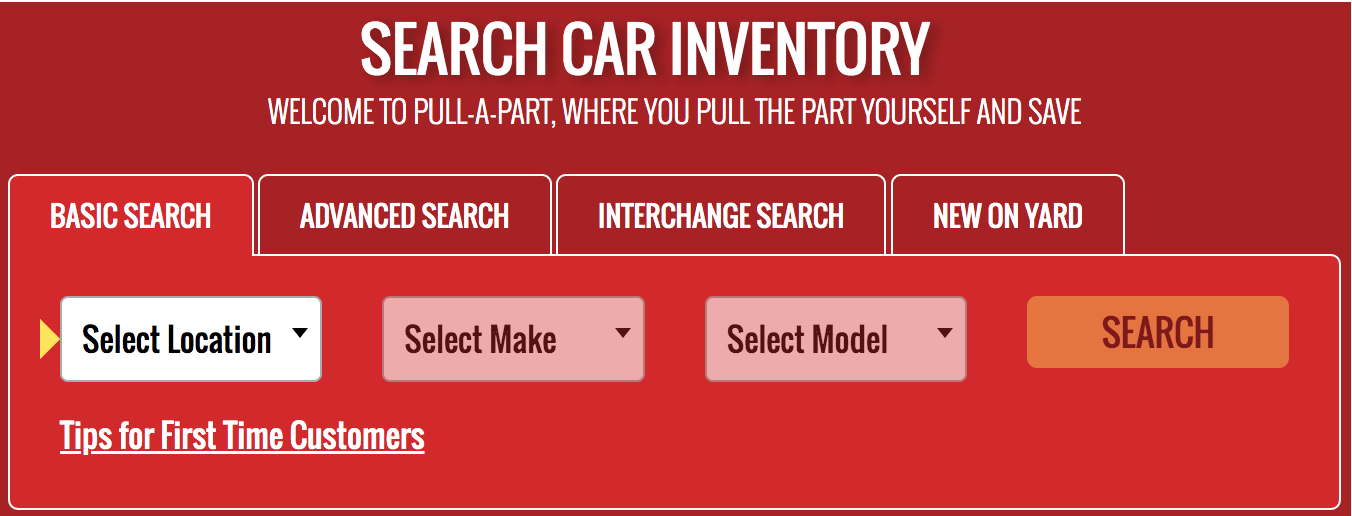
- Search current inventory. Use Pull-A-Part's vehicle inventory search to see which matching vehicles are on the yard at your chosen location. The website is updated nightly. Pull-A-Part tracks whole vehicles rather than individual parts, so the vehicle may be listed even after someone has already pulled the part you need.
- Check engine and transmission details. On many search results, the "View" button shows engine, transmission, and body-style information. Pull-A-Part doesn't record odometer readings, so it suggests estimating mileage from the model year using a rough figure of about 10,000 to 15,000 miles per year.
- Look for alternate donors. If your exact vehicle isn't available, run an interchange search to find other makes and models that may use the same part.
- Watch for new arrivals. The New On Yard listing shows recently set vehicles, and a free Notify Me alert can text or email you when a specific year, make, and model arrives. Pull-A-Part notes that it does not set new vehicles out in rows on Saturdays and Sundays, so weekday arrivals are worth watching if you want first access.
- Know the price before you go. Pull-A-Part charges the same price for a given part regardless of the vehicle's make, model, or year. Review the current used auto parts price list, and remember that core charges, taxes, and fees may apply. Bringing your old part with you can help you avoid paying a core charge.
- Pack the right tools. You'll need to bring your own. Vehicles are set on stands, so you don't need a jack, and jacks aren't allowed. Torches, grinders, and other spark-producing tools are also prohibited, along with car batteries and gas cans. Battery-powered tools, small hand-carried generators or compressors, and jump packs are allowed. Review the current tool rules in Pull-A-Part's used auto parts FAQ before you pack.
- Plan your timing. Yard admission closes 30 minutes before the store does, and visitors must be at least 16 years old. Stores may adjust hours during bad weather, so check your location page before heading out on a winter day.
- Keep your receipt. According to Pull-A-Part, most parts include a 30-day exchange or store-credit warranty with a receipt, wheels and tires have a shorter window, and some parts qualify for an optional extended warranty. Review the current return policy before you buy.
What to Bring for Ohio Yard Conditions
Beyond a basic metric and SAE socket set, bring extensions, a breaker bar, wrenches, screwdrivers, Torx bits, pliers, a pry bar, and plastic trim tools. Penetrating oil is especially useful on older Ohio vehicles, where rusted bolts are common. Pack work gloves, safety glasses, sturdy closed-toe boots, and bags or containers for fasteners. Yard surfaces are gravel rather than pavement, and Pull-A-Part provides free wheelbarrows for carrying heavier parts. Take photos of connectors and routing before you disconnect anything so reinstallation goes more smoothly.
Short on Time or Tools?
Pull-A-Part is a do-it-yourself operation, but it also offers limited part-pulling service for some parts at an additional fee. The list of eligible parts and fees can change, and you still pay for the part itself. Pull-A-Part does not ship parts or transfer them between stores.
Quick Answers About Buying Used Auto Parts in Ohio
Can I buy a whole vehicle from the salvage yard?
No. Pull-A-Part can sell parts from the vehicles on its yard, but it cannot resell those salvage vehicles as a whole, even for use as a parts car.
Can Pull-A-Part tell me whether a specific part is still on a vehicle?
No. Because customers pull parts all day, Pull-A-Part inventories vehicles, not individual parts. The only way to confirm a part's condition and availability is to inspect it on the yard.
Are used parts from high-mileage vehicles still worth buying?
Often, yes, especially for body panels, lighting, interior parts, and trim, where mileage matters little. For engines, transmissions, and other wear-sensitive components, inspect carefully, estimate the mileage, and weigh the part's price against the risk.
Pull-A-Part's used auto parts section covers more about searching inventory, pricing, and how the self-service process works.
When the Car You're Fixing Isn't Worth Saving
A junkyard trip sometimes reveals that a repair will cost more than a vehicle is worth, especially when major mechanical work and serious rust show up at the same time. If you reach that point, it may make more sense to sell the vehicle than to keep investing in it. Pull-A-Part buys junk, damaged, and salvage vehicles in several Ohio markets, and you can request a quote to sell your junk car in Akron, get cash for your car in Canton, or sell an unwanted vehicle in Cleveland. Offers depend on the vehicle, so contact your local team for current details.
If you need dependable transportation after retiring your old vehicle, you can also shop for affordable used cars in Akron, find a budget-friendly used car in Canton, or browse quality used cars in Cleveland West. Inventory changes regularly, and an affordable vehicle is still worth inspecting carefully or having checked by a mechanic you trust before you buy.
Make Your Next Ohio Junkyard Trip Count
The vehicles most common in Ohio junkyards are the popular sedans, pickups, SUVs, and minivans that drivers relied on for years. That volume works in your favor as a DIYer: more donors mean more chances to find a clean body panel, a working alternator, or a matching interior piece at a fraction of the cost of new. Check current inventory, confirm fitment with part numbers and interchange data, pay close attention to rust on anything mounted underneath, and keep E-Check in mind if you're replacing emissions parts in Northeast Ohio. With the right preparation and tools, a trip to an Akron, Canton, or Cleveland West yard can save you real money on your next repair.


